Dissolve and Integrate: On the Shadow, Sexuality, & Aggression
Growth inherently carries a contradiction at the beginning of the journey of transformation towards the new self.
A Contradiction
On the one hand, we come to realize we are insufficient. A problem requires us to let go of our current identity so that we can become more—more developed, robust, adaptable, or flexible—more mature. Metaphorically speaking, we have to burn off the proverbial “dead wood,” the stagnant parts of ourselves, to find the parts that are valuable and make room for new growth. We may even have to undergo a phoenix-like transformation with a metaphorical death of the old self and a rebirth into a new self.
On the other hand, forward motion often also requires that we find something we lost when we were young. In some cases we seek a lost ideal, maybe wonder, altruistic love, reverence for life, or beneficial religious beliefs thrown out with the hypocrisy of leaders. Sometimes becoming a parent, an empty nest, or retirement from a career provides a natural inflection point for regaining lost parts of ourselves. However, oftentimes the thing that we must regain is more confusing, such as accepting our animalistic instincts, our individual aggression and sexuality, or our group-oriented emotional and bonding traits. This is sometimes called “integrating the shadow,” the parts of our personality that we dislike, the parts that we attempt to hide or reject. While often including our animalistic id (sex and aggression), it may also include a repressed but self-focused ego (self-promotion, creativity, leadership) or the altruistic but exploitable superego (group-bonding, morality).

Peter Paul Rubens' The Death of Adonis whose failure to listen to his lover Venus’ premonitions resulted in his death by beasts. A classic by Ovid wherein the arrogance of a man causes his failure to listen to his soul and succumb to his base nature; the opposite is also true, as Adonis also represents the soul of Venus.
We are often dominated by one of these internal parts and reject the others to protect relationship stability or maintain our personal security against the intrusions of others. We fail to realize that we are already risking by identifying only with our ideals or self-protective instincts. Being the domesticated species that we are, we usually know that pro-social connection is better than animalistic behavior because we can do more and get farther with group support. However, we also fail without access to our self-protective and sexual instincts.
Psychologist C. Jung wrote, in defiance of the superego, “I'd rather be whole than good” because our false good self, the superego, is likely to do more harm in the attempt to prove itself good to others. Our whole, integrated self is more likely to act with compassion and non-judgement towards other people, who are also inherently complex and flawed creatures. Integrated is better than good because the perfect ideal is a judge which condemns others and cuts us off from the group. Integrated is better than good because it supports sympathy and empathy yet also allows for self-protection and self-promotion towards our own goals. Integrated allows for true acceptance of self and others but sets a healthier, stop-loss point.
This leaves us in a paradox. Some parts of ourselves must be rejected, but other parts that were suppressed or rejected improperly need to be integrated or reintegrated to allow our growth and transformation. So, which difficult behaviors, ideas, values, relationships, parts, etc. do we reject properly, and which do we integrate?
Dissolve and Integrate
In the years following the western spread of Christianity, the alchemists elevated this idea to a prime dictum, Solve et Coagula which means “dissolve and integrate.” This formed the initial basis for the transition from intermingled religion/philosophy/medicine to separate forms of study—psychology, philosophy, theology, chemical science, medicine, and physiology. Alchemists thought they could transform humans into masters of all elements, and in a way they succeeded by defining change processes across nature and creating the sciences, including psychology, which defines emotional and cognitive change processes. Solve et Coagula has evolved to psychological integration.
Psychological integration begins like this. Imagine you had a parent with poor control of their emotions. This made them a fickle and angry person, but they generally treated you well apart from that. After trying out their behavior for yourself and getting bad reactions from both your parent and others, you subconsciously decided to bury these emotions, cutting yourself off from your own aggressive feelings. On the surface, this moral structure might appear to be good character, yet it also criticizes all of the possibilities your body and emotions provide, setting you against yourself. Rather than learning emotional control, you have stripped aggression of any ethical use or value and have learned to not feel your anger. You may live in fear of your necessary emotions, or worse be proud of your inability to feel deeply and live crippled, without realizing it. You may even have adapted to become a caretaker for your parent’s emotional state. Now when you encounter a situation which requires self-protection or self-assertion for success, you realize you lack the emotional tools to be taken seriously—you struggle to break away from your parent to become your own person; you lack the rage to fight off an assailant; you lack the assertiveness to romance potential love interest or walk away from a bad relationship; and you cannot even negotiate a promotion at work.
The reality of the situation is that you are crippled and deceived about your morality, which hides covert cowardice. We are afraid to hurt other people and be rejected so we take no action and let others choose what to do and then claim we are moral because we did not contribute to the negative outcome. We are afraid to make decisions that might benefit ourselves and cause us and others to feel that we are guilty of selfishness. We may suddenly lose control, dominated by the anger we loathe and then become ashamed, so we must blame others for our weakness. We mask our fear and cowardice, our domestication and followership, our abdication of responsibility and lack of control, with false virtue and blame. We have to let these false protections go, and risk to find true virtue.
Simplified Morality
Traditional morality often feigns righteousness but hides a fear of doing wrong, causing an abdication of responsibility for integrating our biological processes. Priests, monks, and nuns serve as the pinnacle of this thinking. They remain celebate and practice nonviolence, solitude, and asceticism, refusing all material gains and biological drives. However, “harmless” does not equal “moral.” Moral, integrated people practice controlled action weighted by personal responsibility, as the founders of psychoanalytical thinking point out. For Freud, this meant reconciling aggression and sexuality, the animalistic physical elements of our body’s hormonal and instinctual id, with our cognitive-leaning superego, which had been overly empower by religion. Yet ego empowerment was jeopardized by innate discontentment and abdication of personal responsibility, seen in the world wars. Jung identified that the enlightenment’s rational-leaning, amoral psyche still supported superego-driven psychopathy, unless the individual embraced the potential of the external, spiritual unknown as a limiting factor. Adler emphasised recognizing individual boundaries to the betterment of self and community prevented psychological possession by tribal, ideological splits while supporting positive communal generativity. Neumann added that accepting responsibility for internal moral struggles between good and evil increased our benevolence.
In essence, many times the elements that need burning off are the excessively simplified, moral structures built by children—bifurcated, dichotomous thinking (e.g. splitting, all-or-nothing, either-or, black-and-white thinking). If these simplified moral structures persist into adulthood, they prevent access to the deeper parts of our psyche, where our assertive, creative, and sexual forces lie. This leaves us unprotected from the psychological manipulation of others. (Note, if a child is frequently unsafe and therefore embraces antisocial forces, dominance of the id persists into adulthood. The prosocial elements of the superego and spiritual unknown must be reintegrated through internal struggle to do good where no good outcome is expected.)
As humans, we usually avoid elements which threaten our connection to the group, especially the primal forces of aggression, sexuality, and creativity. These forces deviate from group narratives and emphasize the success of the individual above others, disrupting the group balance, so it makes sense that we avoid them when we are young. However, once we mature, if we continue to suppress the parts of ourselves which might be responsible for the worst outcomes, we also deny ourselves access to the best parts of ourselves. We cannot be good people or make difficult decisions without access to our aggression because we cannot say “No” or make requests or take risks. Even if we try, no one will take us seriously if we lack the emotional resolve to back up our choices. Without access to our sexuality, we cannot form romantic relationships nor reproduce and transform into parents. Even if we do by some miracle create a child, we will not be able to set boundaries with our children or model a loving, parental relationship, harming our child’s chance for romance in the future.
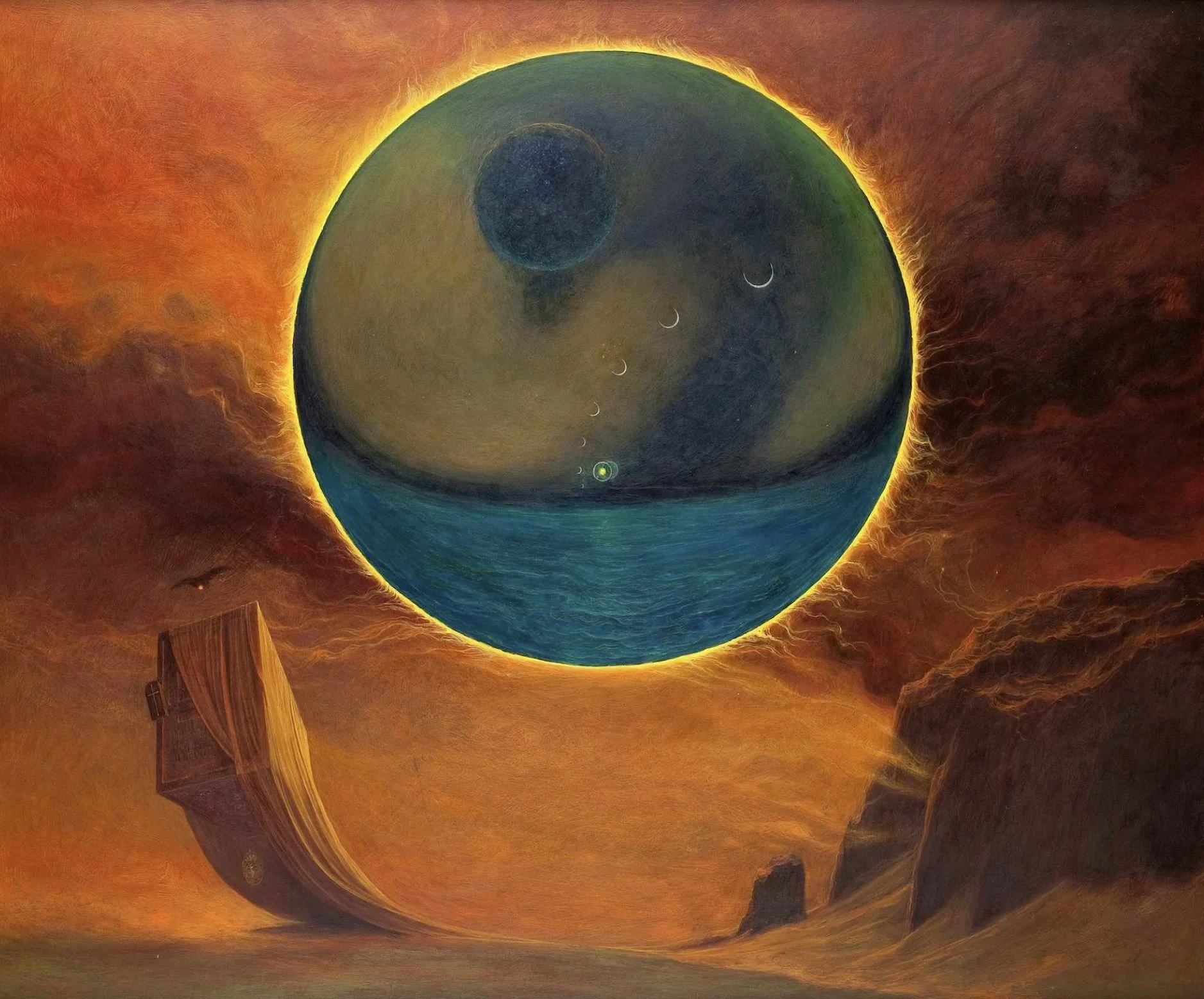
Zdislav Beksinski Untitled 3
The Shadow
This is where the idea of “the shadow“ comes in. Modern psychology was initially built by individuals during the world wars, as they attempted to understand the brutality of the 20th century and the shift to science. They were haunted by the question of what to do with the darker parts of our personality, the parts which are potentially malevolent, retaliatory, and violent. The moral, superego response is to hide, crush, or dismiss those parts which feel fundamentally opposed to altruism, so we defer to our group leader for absolution, choose inaction, or close our eyes, cutting ourselves off from the id or responsibility for what it leads us to do. This leaves us only half functional, unable to act in the service of good when necessary, and denying responsibility for our wrongdoings.
The contemporary answer is we ought to invite those parts of ourselves out to play so that we can learn to use them appropriately. This is one of the functions of school sports, to allow teens to learn to control or discipline of their aggression, harnessing it for a greater, inclusive goal. Violence isn't virtuous, but neither is the inability to protect someone in danger. Likewise, promiscuity isn't virtuous, but neither is unavoidable virginity—someone who claims to be moral but cannot lose their virginity is dishonest and incomplete. Virtue requires the ability to make the opposite choice. Art and creativity aid in this process, demanding the dismantling of older structures to disorder before creating a stronger or more beautiful order. To be whole, we have to interact with the shadow, the parts of ourselves which hold the potential for violence or sexuality or chaos—we have to form romantic relationships and learn self-assertion and learn to recreate order. A moral or ethical person is able to do things that they choose not to do. They could take action, but they choose not to because they understand the implications of their decisions and make a better (usually more long-term oriented) choice.
An Answer
This is where the difference between integration and rejection become meaningful. We reject, release, or burn away anything which prevents integration, understanding, or adjustment to the reality of the world. We mature. We dissolve, through difficult processes which disassemble the old order of things, and then reconstitute ourselves in a way which works better with our new understanding of the world, regaining access to the previously limited parts of ourselves. We tear down the old city following the war and then rebuild. We step away from our old self.
As we age, the process of dissolution and reintegration is continual, and our brain is built for this. The right hemisphere processes new information and the left hemisphere incorporates information to the previous order. Neuroplasticity allows the brain to continually adjust to conceptual and environmental changes. As children, we do this continually as part of growth, but then often find ourselves out in the world and functioning in a way adapted for our old family or school environment rather than the real world. Either our family was too protective so we lacked the capability to self-protect or it was toxic and the world holds potentially worse possibilities. In either case, we struggle with self-trust and the terror of the unknown.
Where to Begin
We are often built too rigidly to begin the process of change. Growth requires a journey but we need a push out the door or a shattering of our former reality. The new order has to take over from the old order. Each generation drags a plow over the bones of its ancestors and plants the field anew. Past generations often reveal the changes needed and are continually passing the baton to the future, even as they improved upon their ancestors. The former order has to be continually shattered for the new systems and heroes to arise.
This is where pride becomes dangerous. People tend to want to be proud of their identity but that stops us from becoming who we could be when life asks us to be something more. If we view ourselves as robust, capable of defeating any challenge as we are, we risk the annihilation of hubris—arrogance. We ought to view ourselves as antifragile, something which grows under stress to become more. We ought to be continually stepping away from our former self. If we fail to do so, we decay, quite literally—untreated psychological disorders are heavily increased risk of dementia.
We naturally fear the transition to the journey because it shatters our previous world and kills who we once were. We fear there will be nothing left of us or we will repeat a past trauma, but that is not true—if we burn away the dead wood we have room for new growth, and if we do this regularly, we continue to grow. We want to be a snake shedding its skin yearly, though sometimes we are a dead forest which must burn or a caterpillar which must dissolve and reconstitute as a butterfly, a metaphorical death and resurrection. The hope for new growth pulls us forward.
Locus of Control
The psychological integration perspective is unlimited, because we don’t know how far each individual can go when they release everything impeding their growth. When people prioritize the future, they rapidly improve their lives, even with very small changes, redirections in energy, or cessation of poor decisions. Life stabilizes when we stop making chaotic choices, but it also improves when we step away from rigid order. We get to choose to walk away from our old self, we get to choose to identify with order or chaos, or better yet to see ourselves as the power which chooses between the two. In this way, the agile, adaptable self is our deepest biological essence and highest ethical aim.
We are an organism which grows from stress—which confronts the unknown and changes—the hero who transforms.