The Courage to be Disliked, and Happy
While Freud claimed the subconscious primarily drives behavior, Alfred Adler asserted that the social environment has just as much impact on individual development and choices. The modern perspective has proved them both right. The BioPsychoSocial Model states we are a combined product of biology, cognition, and environment. This article is a summary of the Adlerian psychological perspective from a modern viewpoint, addressing issues such as trauma, boundaries, shame, choice, praise, control, and more with a few additional perspective added. For deeper exploration, I recommend The Courage to be Disliked and its sequel, The Courage to be Happy, which describe an individual struggling to implement these concepts in daily life.

La Lutte by Emile Friant
All Problems Are Interpersonal
All personal problems inevitably become interpersonal problems. At our core, homosapiens are a social species, forming the largest and most complex social groups currently known. We are equal parts predators and domesticated, familial, social animals. While nature presents us with hunger and pain, emotional suffering comes from comparisons or conflicts with people. We continually seek approval, control, distance, connection, or superiority in our social groups. We are unable to maintain sanity in isolation, and if one of us has a problem, it frequently becomes a problem for the group.
For example, if someone is frequently drunk or unemployed, a lot of their problems will be social reactions. Immediate partners, children, or family may become upset initially, then if the problem continues, it impacts their social networks and community acceptance. They may hurt people and lose relationships, causing feelings of loss. They may change friends to find support for their choices, however poor, and cause problems for others. Eventually they may be forced to live somewhere else other than a home, and become a problem for local law enforcement, government workers, or rehabilitation specialists.
Alternatively, consider a child who is disruptive at school. They are likely to be perceived as harmful to other students’ success but also a poor reflection on their parents’, teachers’, and school’s reputations. They might get into fights (peer issues), become grounded (parental issues), be removed from class (teacher issues), or expelled from school (school issues). Individual problems inevitably become group problems.
Trauma Isn’t Real
Psychological trauma is not an objective reality beyond the individual person. Trauma may influence behavior, but trauma does not determine the present. Two people can go through the same circumstances, with different responses that lead to wildly different mental outcomes. One person may develop a trauma response such as PTSD, while another person may move on with life, untroubled or even stronger. It can therefore be said that trauma is not real. Only our perceptions or interpretations of our problems are real, and then only real to us.
The difference between trauma or growth is the flexibility to adapt to environmental changes, whether gradual or shocking new information that requires an update to our worldview. We resist a reality which carries the potential for pain or seems to reduce our control, power, or safety. When individuals respond to so-called traumatic events with action, they are often strengthened rather than traumatized. For example, imagine a bus crashes in a river and while the bus is being pulled into the water, several children direct/help the others to get to safety. The children helping are unlikely to suffer PTSD and more likely to develop confident leadership traits. The children who needed to be helped are more likely to feel powerless, out of control, and traumatized, no matter their age. Limiting beliefs compound and keep us weak. True freedom begins when we accept reality as it is, and not as we fear it to be, nor as it was. That gives us the freedom to do our best, but let go of the outcomes.
Trauma is so dependent on perception that it can be cultivated in others then exploited for control or power. Some people use deterministic narratives for self-justification, such as “If you do things I don’t like and threaten my control, then I have the right to further disempower or reject you.” This is frequently phrased as, “If you don't respect me, I won't respect you.” Hierarchical competition is their reality. They entitle themselves to unearned power or advantage, violating boundaries, exploiting others, and creating traumas. This creates new interpersonal problems and distorts relationships, causing defiance towards authority figures, group narratives, or the law. In repetitive cases, ignoring reality to push one's power or agenda can even produce dementia in the exploitative person. Freedom begins when we relinquish deterministic narratives and entitlements, controlling only our worldview and environment, rather than seeking control over other people.
We Choose Unhappiness
If trauma lives in the mind, why do we suffer? We often choose unhappiness because it serves a social purpose, such as avoidance, protection, or self-justification. We delay a task to avoid discomfort, protect our time, or justify our self-worth, even though we could complete the task in less time and with less energy expended than our mental resistance requires. This grief cycle of denial, anger, bargaining, and disappointment usually takes more energy from us, but we may also get stimulation from our cycle of resistance, if only subconsciously. We could just as easily do the task and get positive stimulation to build up our happiness and self-esteem, but we chose unhappiness.
We can easily invert this cycle. If we are going to be unhappy anyway, we could do the task and take conscious pleasure in our unhappiness and negative emotions. In therapy, this is sometimes called the reversal of desire, where the suffering is perceived as exciting, challenging, or proof of effort, which feels good. We take pleasure from the difficulty of our action, the suffering which grows us, the improvement to our world, the knowledge of good things to come, or the rebellion against inaction. We choose to feel satisfied even by the pain of our effort, without placing pressure on others. We choose happiness.
Some people are so unconsciously given to the cycle of leveraging unhappiness that they become codependent. They gain stimulation, pleasure, or advantage from social power trades and bad outcomes, doing good things for others and gaining secret excitement, leverage, or support from others’ shortcomings. The codependent chooses unhappiness to manage conflict, justify future bad behavior, gain support, or compel others to obey, but they suffer volatile emotional cycles and become needy, bound to others in a disordered way. They choose unbalanced unhappiness because they are too closely bound to the dominance or subservience of others. They would be better served by finding happiness in self-control of their efforts and actions.
The Separation of Tasks
In choosing happiness, will we be exploited? As social animals with social needs, we often confuse our tasks, responsibilities, and needs with those of others. Codependence damages social groups with denial, manipulation, and low self-esteem. Interdependent groups work together to self-manage as interdependent individuals. The focus on personal responsibilities frees us both from attempts to manage others’ thoughts, feelings, or actions and from others’ attempts to manage us. When personal tasks are owned and boundaries understood, people reduce interpersonal problems and clarify actionable solutions.
We are responsible for our tasks, but can ask for help or offer help to others. We can offer informational, emotional, and active support when appropriate, but others’ choices are not ours to decide, and many tasks are not ours to complete. They are not our responsibility. Consider a student and teacher. It is the teacher’s task to present information for the purpose of learning. They present what is deemed to be relevant and accessible by scholastic authorities and use a methodology which supports student mastery of the information. It is each student's task to complete their assignments as directed and ask for additional support from competent authority figures when needed and available, according to the student’s age.
Problems occur when we take responsibility for the tasks of others or refuse needed help and fall behind. It is the teacher’s task to keep order, make the material engaging, and support logical thinking. However, it is not their task to manage individual thoughts, feelings, and behaviors. If a teacher lacks proper task separation, they may react with anger when students dislike a favorite subject, act out in class, or profess contrary beliefs. Likewise, students who fail to ask for help when it is needed may delay their work until they panic, beg for extensions, or cry due to failure. Emotional reactivity is the result of crossing task boundaries.
(Note that following the world wars, modification of US schools to a militaristic “Prussian” model changed the teacher/student relationship into an officer/soldier relationship. As a result, teachers often force some level of subordination and decorum in the classroom. Some parents have also adopted these authoritarian systems, forcing compliance rather than supporting play and building social skills. These “task violations” strip children of self-determination, creativity, and leadership potential, traits essential to entrepreneurship and success, even in corporate environments. In California, Montessori and Waldorf schools are pioneering new systems with outcomes which far exceed current public schools, in part because they have moved away from subordination models.)

Anna Pavlova als Bacchantin by John Lavery
Freedom to be Disliked
True freedom is the courage to be disliked – acting from personal conviction rather than a need for validation. Validationmay be confused withaffirmation. Validation is self-worth and only comes from our internal self-regard, our healthy ego. Action naturally comes from the wellspring of curiosity, supported by a positive identity that is built on the internal validation of a healthy ego. It is ours alone.
Validation must come from within, and is often the early voice of parents inviting us to love and explore or causing us to feel shame in our identity in order to keep us limited in some way. Often that limit is meant to protect us, but it becomes a cage. Shame overwhelms and creates compliance, preventing action and deferring to external control. Shame, a lack of internal validation, therefore causes us to externalize our ego, relying on others to determine our thoughts, feelings, desires, and behaviors. Some may place their ego into a religion or job, external stability constructs, and emphasize performance or perfection. However, this leaves them vulnerable to the collapse of their identity if they encounter a negative reaction, reprimand, or loss, such as being fired, even if the loss is unjust.
As we are social creatures, membership in a group often provides more security against invalidation than one’s ego. However, there is a cost. Sports leaves us vulnerable to injury or unable to influence team dynamics. Organized religion offers acceptance as an extension of tribal group-think, requiring us to reject or embrace other groups or leaders to maintain membership in the current group and may even offer cognitive outsourcing from existential work and moral absolution from group decisions. This erodes boundaries, makes us subservient, and leaves us vulnerable to hierarchical power. It threatens catastrophic loss of community if we question, fail to conform, or refuse to submit to tribal leadership.
Unlike validation, affirmation is confirmation of positive action. Wrong action towards others creates a negative response which is felt as guilt. Guilt causes us to examine our actions and redirects us towards proper, beneficial behavior. A little bit of guilt over improperly acted-out values can help us to understand when we are out of line with our core self or goals, but does not target our identity or inhibit growth. Guilt is also more resistant to manipulation, allowing us to recognize if someone is treating us unfairly and helping us maintain proper distance from those who would pull us into toxic, manipulative, codependent relationships. The courage to be disliked protects us from exploitation without inducing validation-based shame. It allows us the freedom to engage with curiosity from a rooted place of strength, and allows good impulses and good outcomes to pull us forward.
Life is Lived as Meaning Chosen in the Present
We are creatures of intention that create meaning through actions we choose in the present. Refusing to choose is a refusal to have meaning or impact, and causes the world around us to decay. The past can dominate our thinking, but the past is not reality and does not determine the future. Each is merely a set of patterns. Meaning comes from taking action in the present to construct something good. Meaning is progress towards solving problems in work, building friendships, investing in a romantic relationship. Our identity is not fused with an essence or outcome, but is continually built. While we can seek knowledge to grow, knowledge without action is empty, and efforts beyond basic survival are useless without people to benefit. Our choices generate meaning to the degree in which they fulfill our needs, solve problems, and help others. To not choose, to not act, to not learn, and to not benefit others are all failures to live. Living is the task of each individual.
Our interpretations determine reality. We decide if symbols or events or trauma define us or our perception of others. Obstacles can be seen as defeat or redirection or growth opportunities. We decide how to view the world, consciously or unconsciously, filtering and categorizing information. Conscious choice over our worldviews gives us agility, flexibility, and anti-fragility – growth when exposed to disorder. If meaning is chosen by us and created by our actions, we are free from the approval of others. Validation, status, or labels only hold the authority that we assign, and have no other authority over our direction. Identity is not inherited nor discovered. Consciously or unconsciously, we choose the meaning of the world around us.

Women at Work by John Singer Sargent
Contribution to Others
Humans have built-in chemicals that drive us towards the need to experience bonding, represented by contributing to others to create belonging. While we choose to determine meaning for ourselves and act in the present, only the choices which improve our sense of useful contribution to the needs and problems of others will truly satisfy us. Ignoring the needs of others is predatory, or psychopathic and sociopathic. Predators experience drives of need and satiation. Everything in their world is subordinate to these drives, objectified, depersonalized, and expendable – children are an extension of self and community is a prey resource. Self-interest and superiority may produce security, but they also produce isolation and fear and lead to negative consequences, suffering, and rebellion. It is a savage, lonely life and a meaningless, empty death.
Choices which contribute to others are the only choices that produce lasting fulfillment. While we are often seduced by hedonic desire or immediate pleasure, these feelings wear off quickly, leaving us feeling unfulfilled and empty. The dopamine from doom-scrolling or a casual sex fades quickly with very little gained beyond the immediate moment. Conversely, long-term-oriented or eudaimonic behaviors create positive feelings from growth; self-actualization increases our capacity to benefit others produces, producing a steady increase in long-term feelings of confidence and accomplishment. Contribution offers positive chemical production from relational bonding, generates goodwill, reduces suffering, increases resources, creates gratitude, and promotes survival of the group. Our brains experience great satisfaction when working towards goals that make the world a better place, in a large part because the brain’s prefrontal cortex is a long-term, problem-solving organ adapted to improve chances of survival. We seek to create safety and stability because the world is unpredictable. Our good feelings are amplified exponentially when we make life better for others.
Community Feeling and Respect
True community feeling arises from equal relationships rooted in equality and mutual respect. While some use the term ”respect” to mean “subordination,” we use “equality” and “mutual respect” to emphasize that community feeling is rooted in positive bonding which values people separately from their utility or hierarchical station. This does not mean that hierarchy isn't important or useful – skill-based hierarchies are critically important to project success. However, it would be false to say that a man who can catch a fish is valuable while a man who makes nets is not valuable. True communities recognize that each person contributes something necessary to the group, according to their skills and group needs in the present and the future.
Community feeling runs deeper than amicable support. Our society has an established baseline for intelligence at which supervision becomes too involved to be productive, yet those who fall below this “IQ baseline” are still supported with care and work that feel redeemable. We even care for individuals with no brain activity because we feel social attachments deeply. We have also learned that euthanizing the weak quickly erodes society into murderousness. Such community feelings recognize that we can learn from the smallest persons and that caring for everyone in the community makes us a more robust society overall.
As we focus on our tasks and become less entangled in others’ tasks, we see other people more clearly. This allows us to trust them to be who they are and interact with them accordingly. We have compassion for their challenges, and can encourage them towards their best efforts. They are freed from becoming entangled in our judgments and find support. They find psychological safety, acceptance, and room to grow. The whole group improves.

Napoleon at the Great St. Bernard by Jacques-Louis David
Vertical Power Corruption
Trauma cycles can corrupt community feeling with vertical power hierarchies or behaviors which lead to hierarchy games, such as codependency. These hierarchies are frequently aligned with territorial or tribal behaviors defining in-group versus out-group individuals, such as religious, political, or scholastic affiliation. They leverage power over others internally on an objective, utilitarian basis rather than supporting equality and mutual respect. Corporations frequently move in the direction of a vertical power hierarchy as the result of corrupting the skill hierarchy required to function. When they focus on power instead of employee support, their people suffer, decisions degrade, and their products begin to do more harm to the world than good.
Families can fall into the hierarchy trap, displaying codependency. This is clearly seen in families with substance abuse. For those who return home after a genuine attempt at addiction rehabilitation, family criticisms and unchanged patterns of conflict frequently cause relapse. Even if the habits have changed and even if the stated intentions of families and partners are good, patterns of unchanged behavior will reproduce the addiction or require the disintegration of family bonds for the rehabilitated person to escape relapse. Negative cycles require someone to play a role which is harmful to them. It is for this reason that drug and alcohol treatment programs emphasize ending some relationships as well as making amends. Making amends helps change relational cycles, creates empathy, supports mutual respect, and corrects corrupted community feelings.
Anger is a Tool
When negative power cycles surface, anger is a normal response. In Adlerian psychology, anger is a physical response rather than hate or vindication, just as sexual arousal is a physical response and not love. It is helpful to describe anger as a tool rather than a true emotion. As a tool, anger is used to control one's environment, whether to protect oneself or to dominate others. In a positive sense, a yell may freeze attackers in place or prevent a child from running into the street. However, anger is frequently misused to punish, force submission, maintain distance, or protect vulnerable emotions. Anger may be misused as justification for aggression or to blame others for our actions.
Anger is harmful when it is an extension of vertical power hierarchies, forcing subordination of others while elevating one's own position at the cost of mutual respect. In a family context, it may cause a parent to lose the respect of a child as they age, cause rebellion, or create aggression towards parents, because children model and reflect parental behavior. Anger prevents parents or siblings from authentically sharing emotional vulnerability, and prevents children from learning how to share with vulnerability and how to receive support. Anger towards children creates anger in children – aggression teaches aggression. Passive anger and aggression create vertical power dynamics that teach children low self-esteem and generate shame.
Praise Creates Shame, Encouragement Creates Agency
Our natural impulse to avoid anger and negativity is to emphasize praise, but this is also damaging. Both praise and punishment are founded on tribal, vertical power which condescends and disempowers, while emphasizing status. For this reason, praise rarely feels accurate and often elicits imposter syndrome. Praise deprives people of self-assessment (especially children), creating dependence. Once dependent, we fear to lose the external sources stabilizing our ego, so we will avoid tasks which have the potential for failure, compel others to act on our behalf to avoid direct responsibility, or demand unjustified validation. Praise causes children to become passive manipulators who are dependent on others for ego reinforcement, codependent.
Encouragement cultivates agency and intrinsic motivation. Personal agency and motivation from within is founded on a healthy ego which believes in personal value (self-esteem). This is typically built by strong experiences of support and encouragement from others. Encouragement allows us to become self-reliant by testing the limitations of our capabilities without fear of losing love and affection (play). While most often developed in childhood, the self-esteem which supports agency can be developed later in life from positive experiences with a healthy group of friends, joining a healthy family, significant changes in group dynamics, a positive mentor, or intentional work with a therapist.
Support and encouragement differ from praise in that it lacks hierarchical language. It empowers people to create meaning without fear of rejection from the community. Recall that trauma is inversely correlated with agency. Supported kids who are encouraged to learn agency through progressive boundary testing and self-controlled exposure (play), build self-esteem which results in the confidence to act. Trauma is only real to us when we are unable to engage with our environment, believing we are weak, vulnerable, and unsupported. In trauma therapy, the disempowering trauma narrative is challenged, the things that conquered us are explored, and new behaviors are engaged. We increase our positive engagement with the world, define our responsibilities, and learn to tell the difference between our meaningful tasks and the tasks of others.
Happiness Flows from Value-Oriented Goals
Community is where we experience most of our interactions and therefore most of our meaning and purpose, which is directly tied to our happiness. Much of our obsession with outcomes and competition comes from a repressed fear of loss or death, and the need to survive. We do not experience happiness from social status, which is a circle chasing security and control, focused on the lower, physical needs like safety. They continue competing, overspending to increase status, but perpetuating feelings of instability and insecurity. When hierarchical language is removed from communication and competition is removed from daily interactions, we experience less opposition and synergy increases. When we stop posturing and competing against one another, we feel part of a larger whole, overflowing to others in collaboration with our gifts – overspending drops, security stabilizes, and we are able to focus on meaningful self-actualization and contribution.
Eliminating competition, outcome obsession, or negative behavior is insufficient to produce widespread change or meaning. Competition and outcomes are essential to assessing competence and can be fun, and survival fear can follow us no matter how secure we become. When we give up punishing people for failing to serve our outcomes, they stop being objectified tools and become valued members of the community. We find true happiness when we invest in value-creating, value-oriented goals. These goals flow into meaningful problem-solving, community feeling, self-esteem, romance, and self-actualization. This generates a deep sense of purpose and connection, whether we lead or follow, win or lose. When our behavior is tied to value-based goals, appreciation for our subordinates, peers, and leaders expands.
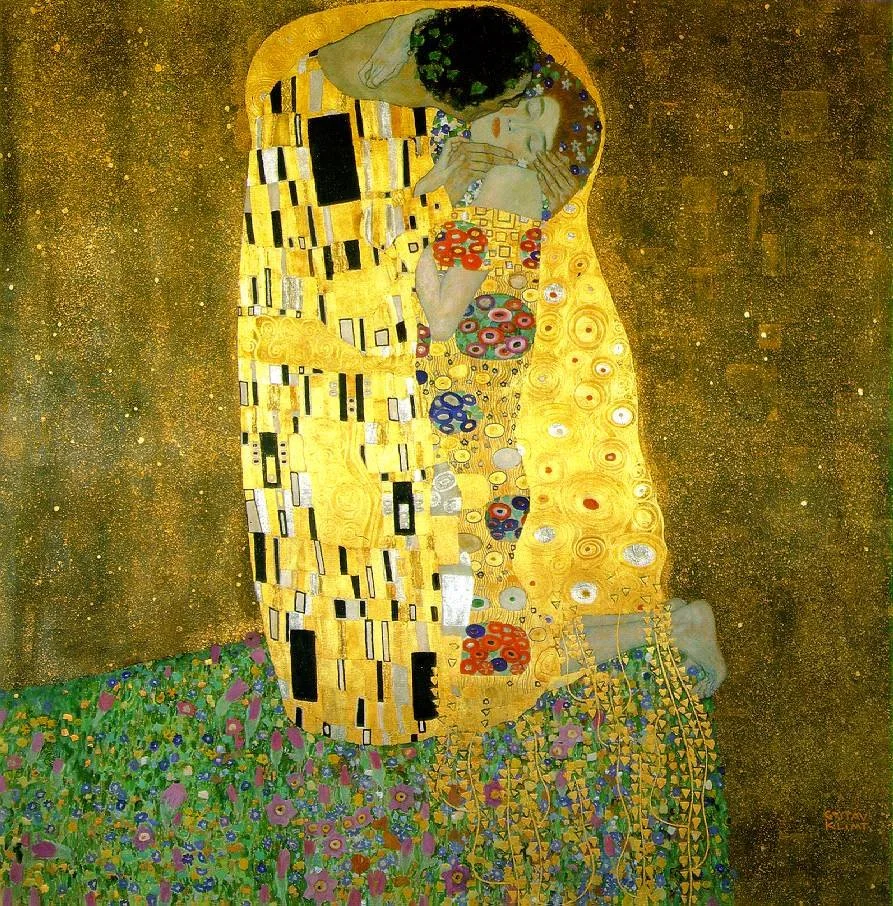
The Kiss by Gustav Klimt
Love Belongs to Equals Cooperating in Shared Life-Work
The benefit of living from values rather than hierarchical status is apparent when people fall in love. Attraction flows from early physiological needs, including sexual, social, and security-based drives. If the relationship is not mutually collaborative in these areas, hierarchy will drive lovers apart when they compete to maintain their respective needs. Competition creates cycles of control and compliance, domination and victimization. In such cases, stability in the relationship is compelled by the fear of loss. Connection primarily flows from expectations surrounding physical desire, financial dependence, social needs, and group conformity. Once engaged in the codependent struggle, relationships are tossed through high and low emotions in cycles of superiority and inferiority, dependency and disgust, aggression and vulnerability or avoidance and anxiety. Relationships quickly degenerate to the “four horsemen of the relational apocalypse” – criticism, defensiveness, contempt, and stonewalling.
When lovers view each other as equals and partners – as two parts of the same puzzle – they are able to cooperate in the movement towards shared life work. Connection is supported by gratitude and appreciation, which perpetuate through psychological safety and comfort in connecting to the other person. Safe acceptance allows for play and spiritual connection, which in turn produce feelings of support and collaboration in progression towards value-oriented goals. Love and belonging support self-esteem and drive self-actualization. Partners become parents and grandparents, building families that allow for growth into old age. Jobs become careers and new ventures generate expansive wealth. Thinkers and interviewers become writers and activists. Counselors become therapists and then psychologists or practice owners. Tinkerers become artists and artisans, and so on. The key is cooperation in shared life work, values, and meaning.
(These paradigms are well defined in Maslow’s Hierarchy and the Gottman House. CODA’s Codependence Checklist can aid in identifying relational problem areas.)
Identity is a Choice, Life Can Change at Any Moment
Our life is not a fixed narrative. The part of the brain which constructs our narratives is separated from the part which makes decisions. We can, at any moment, take a different viewpoint, choose a different action, adopt a new pattern, experience a new outcome, and determine the meaning of that decision to us.
What we perceive as our “identity” is a desire to feel complete by filling in a missing part, often to make up for a childhood scarcity, and more often to force someone else to fill in for what we lack. We know how to be good parents by doing the opposite of what hurt us as children. We may gain financial stability by chasing dreams or finances our parents gave up. We may define our honor by pushing ourselves to the piety others only feigned or pursue social status, seeking honorifics others denied us. Defining ourselves in opposition to a negative experience leads to a perpetual sense that we are not enough. It creates failure in other areas. The more power we give to external forces and definitions, the more we become defined by the failures of others and remain dependent on the validation of our children, partners, parents, peers, bosses, and mentors. We feel increasingly helpless without external input.
We are not a fixed essence. We are impacted by social training and biological trait inheritance, but we get to choose our actions and our story. We are not our thoughts and we are not our emotions. We are the decisive force which determines meaning and outcomes. We are the identity which chooses and acts. At any moment we can choose to view ourselves as a complete being and take action to change our world. We can start overflowing into others instead of needing them to flow into our deficits. Our identity then becomes a series of chosen viewpoints, stretched across goals and dreams that uniquely belong to us. We cease to be defined as a reactionary response that is subject to the validation or judgement of others. We can pursue skill while embracing failure. We can raise children to become their own people who have their own unique stories. We can love without fear of loss, and we can lose without loss of love.
Compassion, Competence, Confidence, and Contribution

Boulters Lock Sunday Afternoon by Edward John Gregory
If we choose to accept ourselves as an ever-changing, positive generative force, our life tasks become much easier, even with all our flaws, hurts, and needs. As we shift our focus away from self-judgement and towards our personal tasks,
We overflow with profound compassion for self and others;
We build competence more easily as we focus on our tasks;
We grow confident in our decisions and others as we become less entangled in their tasks, and
We increase our capacity to contribute to the needs of others and become more useful to the community.
Responsiveness replaces reactivity, and intention replaces distracted rumination. Dreams and lifelong goals begin to become accessible. The community benefits from our growth, and we feel connected. In other words, when our feelings (affection), thoughts (cognition), and actions (conation) are able to join together as a holistic unit, we become enabled to act with intention and experience true social connectedness.
There is a contradiction involved. Growth requires awareness of limiting, negative, and harmful behaviors. We must move away from the past patterns of living to move towards better patterns. When we self-accept, we experience compassion for ourselves and for others, which allows us to build competence without the fear of failure or the shame of appearing foolish. When we are focused on contribution to those around us, we take risks that tend to have a more realistic understanding of our role and our present skill level. Our efforts become more optimistic and confident, even as course correction becomes more frequent. We transition from a static, self-justifying mindset to a growth mindset which supports positive change. We become an anti-fragile organism which adapts and modifies our environment for the better. Rather than feeling compelled to move up the hierarchy by the desperate fear of collapse, we become curious about what we might build or create. We become compelled by a sense of self, a deep interest in the world around us, and the desire to benefit others, without doing their work. We call the community to join us in our movement forward into a better world without judging or denigrating the one which currently exists.
We will experience resistance. Others invested in social, financial, moral, emotional, and ideological hierarchies may not like these changes. Courage may be viewed as a violation of others’ sovereign power – and it is. They will claim they suffer when we deny them control over our tasks or refuse to take on their task – and they do suffer. They may beg for validation of their dominance or weakness in the hierarchy, and they may even need that validation, but we cannot give it. Their demand for control over the perspectives and lives of others is their task to resolve, not ours. Each person must find self-compassion and self-acceptance themselves. Our task is only to affirm the good, support when we can, and encourage when we are unable to help.
We can have the courage and compassion to face dislike or misunderstanding. Our courageous task is to self-accept, then leverage our values towards personal growth, which expands our ability to improve the world for the greater community. We can have the courage to be happy in our growth, success, generosity, and self-actualization. It is this pursuit that we will find happiness.